How One Google PMax Campaign Generated $1.54M+ in Sales
ClientFireplace Store - USA
My roleGoogle Ads Management
Timeline6 Months
PlatformsGoogle Ads · GA4 · Merchant Center
Click to enlarge
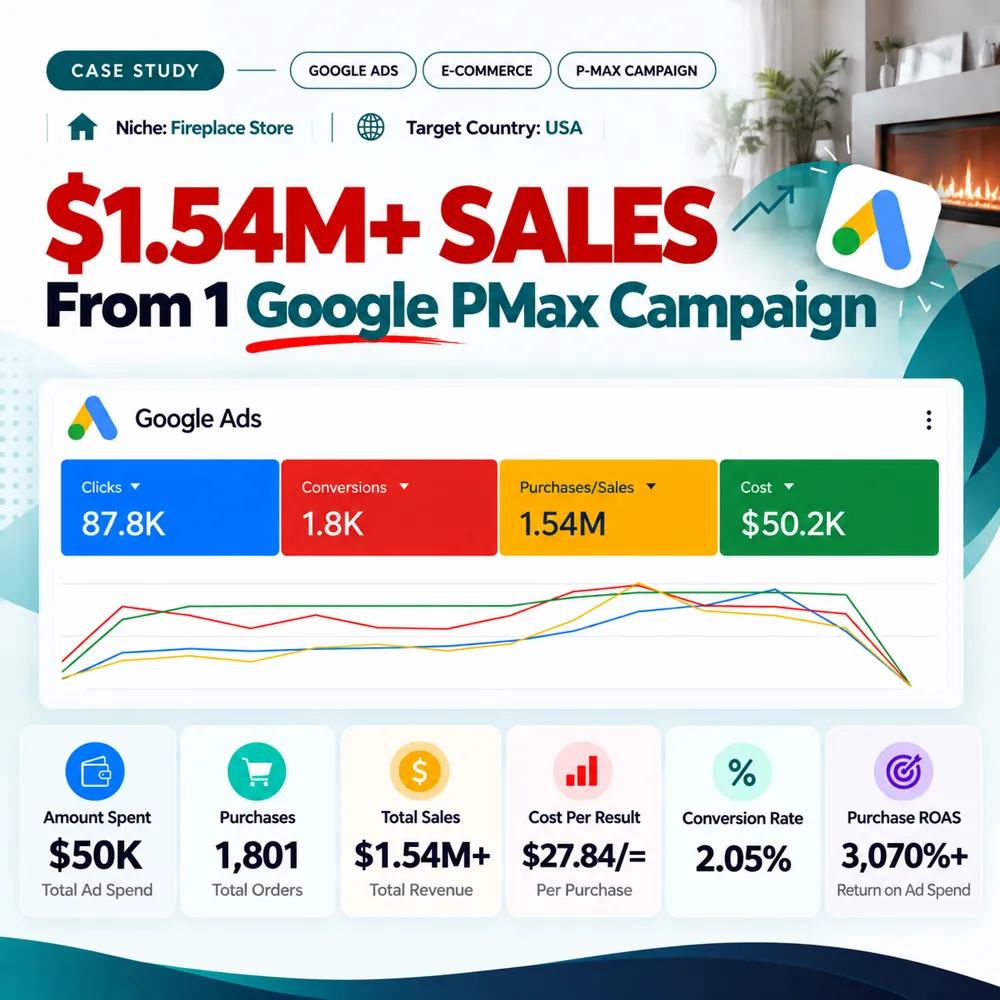
$1.54M+Total Sales
$50KTotal Ad Spend
1,801Purchases
2.05%Conversion Rate
THE PROBLEM
High Spend Potential, But Multiple Leaks in the Funnel
When I started working on this project, the challenge wasn't simply getting more traffic. There were several performance and infrastructure issues limiting the account's ability to scale efficiently.
The initial audit revealed gaps across campaign structure, conversion tracking, product pages, feed organization, and budget allocation.
The account needed a stronger foundation before increasing spend.
Goals
Build the Foundation First, Then Scale What Works
Identify and eliminate budget leakage across campaigns
Fix conversion tracking so purchase data could be measured reliably
Improve product-page experience and conversion potential
Restructure product feeds with country-specific mapping and better signals
Establish stronger search and conversion signals before launching PMax
Build a structured PMax framework around products, audiences, and creative assets
Identify winning Asset Groups and scale them based on actual performance
The Process
How it was done
Ads Account Audit
Audited the existing Google Ads setup, conversion tracking, campaign performance, budget allocation, product data, and overall customer journey.
Why
Before scaling spend, I needed to understand where performance was being lost and which parts of the funnel were creating unnecessary leakage.
Fixed Conversion Tracking
Reviewed and fixed the conversion tracking setup to ensure purchase data was being captured correctly and could be used for optimization.
Why
PMax relies heavily on conversion signals. If the purchase data is unreliable, campaign optimization becomes unreliable too.
Improved the Product Experience
Reviewed the product pages and identified opportunities to improve the design, information structure, and conversion experience.
Why
More traffic doesn't solve a weak conversion path. The product page needed to support the traffic being generated by the campaigns.
Built the Search & Feed Foundation
Started with a controlled Search campaign to capture relevant demand and generate higher-quality traffic and conversion signals.
At the same time, I reorganized the product feed with country-wise mapping, product structure, and stronger feed signals, then gradually warmed the feed before moving aggressively into PMax.
Why
Rather than immediately putting the entire budget into automation, I wanted to establish stronger data and product signals first.
Launched a Controlled PMax Framework
Launched PMax with a controlled budget using multiple Asset Groups, each supported by a structured creative and audience framework.
The campaigns were built around relevant products, messaging, creative variations, and audience signals.
Why
The objective was to give Google's automation enough structured information to identify which products, creatives, and audience signals were producing stronger purchase outcomes.
Optimized & Scaled the Winners
As performance data accumulated, I monitored Asset Group, product, creative, conversion, spend, and revenue performance.
I gradually shifted attention and budget toward the combinations demonstrating stronger results while optimizing underperforming assets.
Why
Instead of scaling everything equally, I wanted the winners to earn more budget based on actual performance.
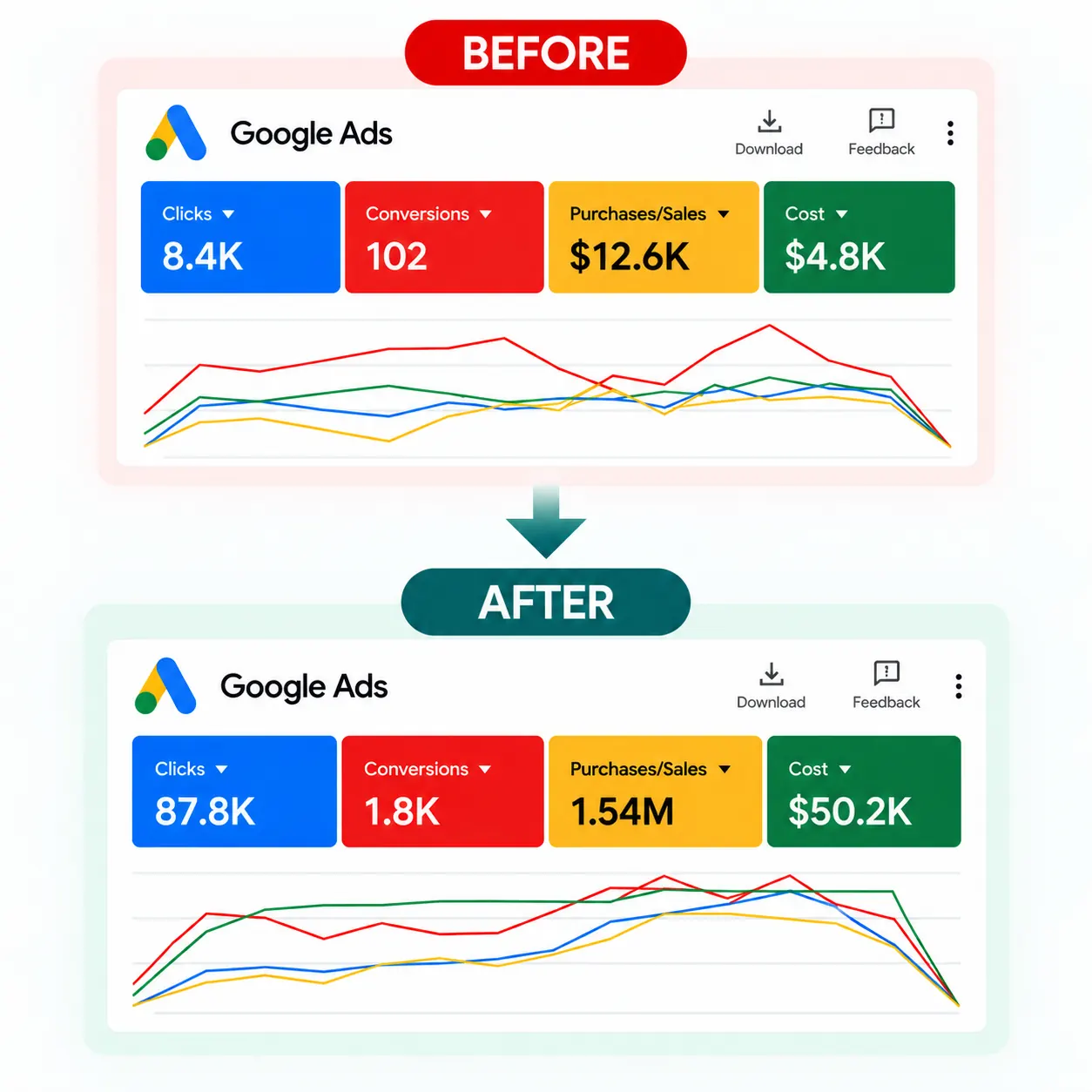
Before & After
Before and after
Click to enlarge
★★★★★
The PMax campaign transformed the way we scaled our Google Ads. The strategy brought in $1.54M+ in sales from a single campaign, while keeping performance focused on profitable growth. The structure, optimization, and on
— Founder, Fireplace Store - USA
Want results like these for your brand?
Let's look at your account together and find the next lever for growth.

 Click to enlarge
 Click to enlarge